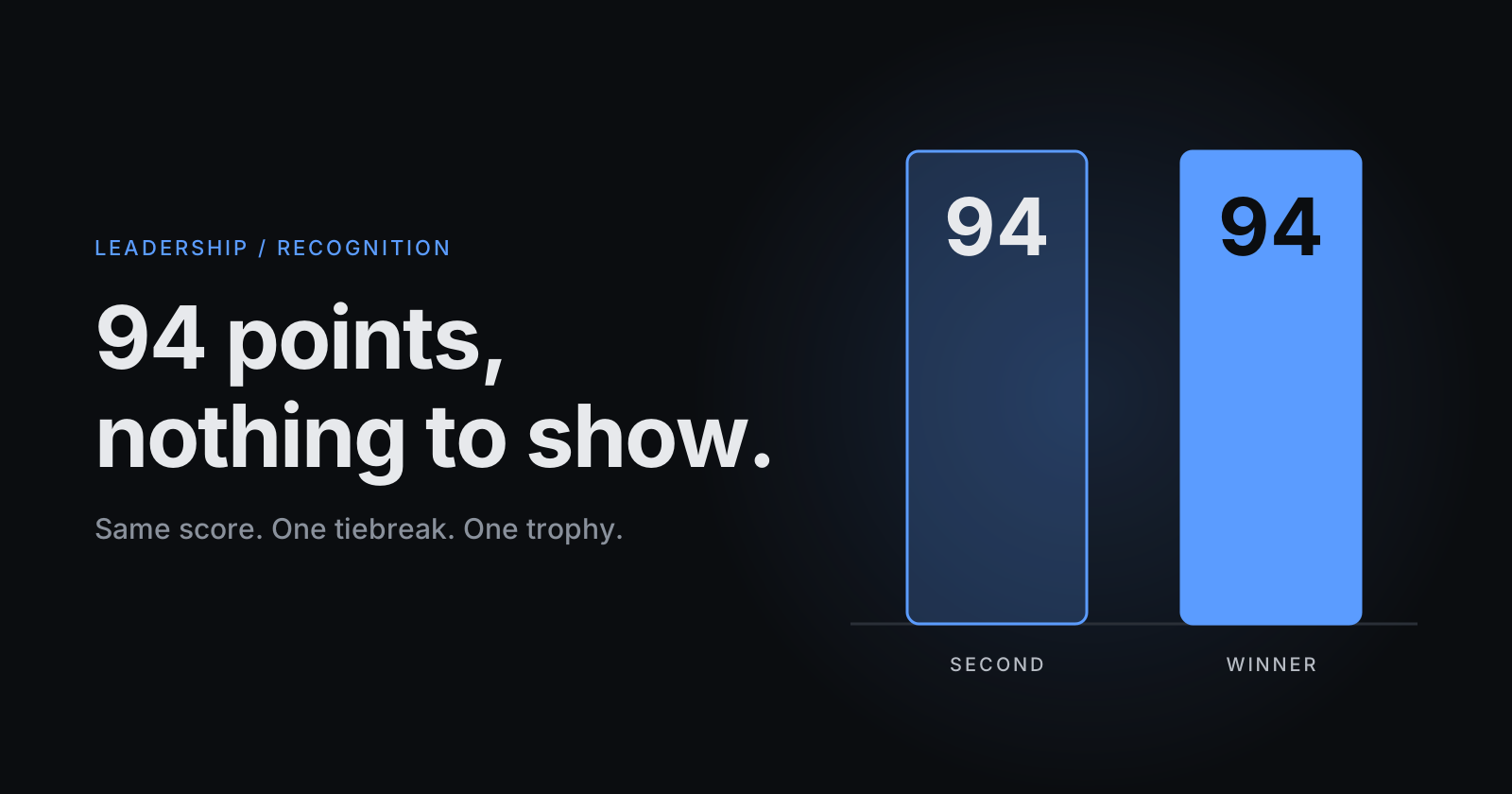
My team finished the final round of a business simulation on 94 points. So did the team that won. They took the tiebreak on revenue, and they took home two prizes: the winner’s prize for our world, and the overall universe prize. We took home nothing, even though the teams placed second, third and fourth overall all scored in the 80s.
I want to tell you how that happened, because I learned more from the three days than the prize would have taught me.
The room
I spent three days at Oracle’s APAC Enterprise Leadership Edge program for senior directors, in Bengaluru. Close to 100 people were in the room, from engineering and product development to sales, customer success, consulting, legal and HR. Many of us have spent 20 to 25 years at the company. Some started as college hires and worked their way up.
That mix was the best part. The conversations across functions were worth the trip on their own.
One honest observation. A ballroom of 100 is not where you have a deep conversation about influence or empathy. At that scale those sessions skim the surface. The depth came from the simulation and from the conversations around it.
The simulation
We ran a company over three rounds, one for each day. In each round we made investment decisions, some for now and some for the future. A simulation scored the results, and those results shaped the next round. Before each decision we had market research, and in later rounds we saw competitor reports too. Some factors carried more weight than others, so investing in the right places mattered.
We were split into four breakout rooms, which the program called worlds, each with about five teams of five. My team was called Vanguard. We finished second in all three rounds.
What we got right
We kept the portfolio simple enough to explain in a sentence. We also invested in sales, so the message actually reached people. We scored well on customers understanding what we sold and knowing we existed. I would take that trade in the real world too. A product people cannot explain back to you is hard to sell.
We handled the surprises well. During each round the simulation threw in pop-up decisions, nine in total. Each one asked us to commit resources and make a choice. The outcome could improve adoption, shake customer confidence, or lift employee satisfaction. I think we got all but one of them about right.
We built a strong employee experience in round one. In the simulation, a better employee experience raised productivity, and productivity set how many resources you could deploy. In our mock town hall, where we told our “employees” how far we had come, that was the part that landed. It was also the part that hurt us later.
What cost us
In round two we trimmed some of the things that drive employee satisfaction. The index dropped, and we could not get it back to where it needed to be.
I think that is why we lost the final round. Our decisions were broadly similar to the leader’s. The difference was that they could deploy more people, whether in sales, customer service or customer success, because their employee satisfaction index was higher and they attracted more talent. We were working with fewer people, and in the end that showed up as revenue.
That one is on us. It is easy to treat people costs as the first thing to trim, and the simulation showed me what that does to the number you care about most.
There was a second gap, and it was retention. The first two rounds showed we had a good backlog of customers on their way to the cloud, but we were losing too many of them. So in round two we invested more in customer success managers and in tools like one-touch onboarding, so customers would get familiar with the cloud faster and stay. Retention improved, but only moderately, not significantly. If it had been significant, I think we would have pushed the winners even closer to the edge.
The lesson there is that winning a customer and keeping one are different problems. We were good at the first and had to work hard on the second.
Poached, then a person down
After day one, each team nominated an MVP, and the MVPs moved to other teams. It was the simulation’s version of what happens in real life: your best people get poached, by another team or another company. We lost ours and got one in return, who worked with us on day two. On day three, for reasons outside anyone’s control, he was not there. Four of us ran the final round’s discussions instead of five.
I joked that the points should be divided by the number of people on the team. By that measure we would have won. That is a joke, but I am proud that we kept 94 points with a person down.
The recognition
The prizes went to the winner of each world, and then to one overall universe winner. The team we tied with won both: the prize for our world, and the overall prize. So they walked away with two prizes, and we walked away with none. Everyone else on stage had scored lower than us.
Some of my team felt it so are others who were in the same world, and it took a while for us to absorb it. We had done very well and still came away with nothing, while others went on stage with less. I understood. And I want to be honest about what I told everyone, and myself.
Being in the right place at the right time can change your trajectory. You may be rewarded, or you may not. In this case we were not.
There was also something we did not know. The tiebreaker was never mentioned, probably because nobody expected the competition to get that close. We found out it was revenue only when the tie happened, and by then every decision had been made.
But look at what we did get. In the debrief, we were in the same room as the winners. We could see how anxious they were about holding the lead, and how close we had come to catching them. We made good decisions and communicated well. The town hall went well. And I got to work with a very good team.
Earlier in my career, being second best while someone who achieved less got the acknowledgement would have bothered me. It bothers me less now.
I do not want to pretend recognition does not matter. In a company, the prize is a promotion, a bonus, or a senior leader knowing your name, and those change careers. I wanted it for my team. So the practical lesson is to ask how you will be judged before the round starts, because a tie goes to whoever the tiebreak favours. Then make your work visible, honestly.
What I will not do is let my sense of how it went depend only on the prize. The experience made me stronger, more connected, and better at reading people, and I am proud of that at this stage of my career. Both things are true. It is not a zero-sum game, but it is not a free pass either.
What I am taking back
- Keep it simple, and put the message out. If people cannot explain what you do, they cannot back it.
- Do not cut what powers the work. People are not a line to trim. Our results in the final round followed from that choice.
- Ask how you will be judged before you start. We did not know how a tie would be broken, and it decided the result.
- Make your work visible, and do not let your sense of how it went depend only on the prize. Recognition matters, and so does what you build along the way.
I came back with a very good team behind me, a handful of lessons, and no trophy. I would still take that trade.
Views are my own.