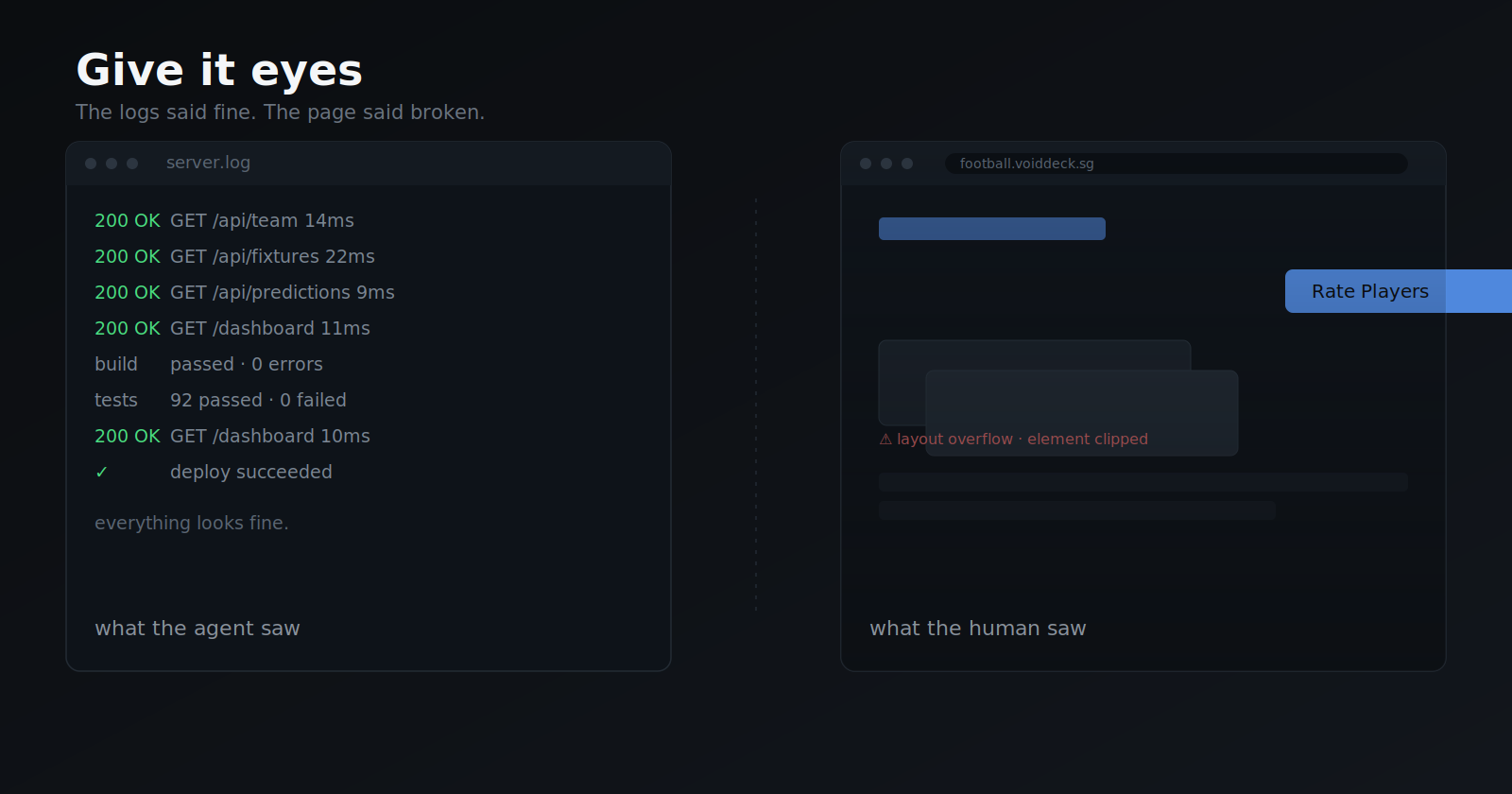
This is Part 2 of a series about rebuilding my fantasy football platform on the Oracle stack and letting an AI agent run the whole thing. Part 1 is here if you want the setup.
Here’s the moment that taught me the most.
The bug that kept coming back
At one point in the build, the agent and I got stuck in a loop. There was a rendering problem on the site — the kind of UI bug where the page looks wrong to a human but nothing is technically on fire. The agent would look at it, decide it understood the cause, make a change, and declare it fixed.
It wasn’t fixed. So we’d go around again. And again.
This happened not once but with a whole run of small rendering bugs — call it half a dozen — each with the same frustrating shape. The agent was confident. The logs were clean. The page was still broken. And every round trip cost a full cycle: change the code, deploy it, and me coming back to say “no, still wrong.”
Why it couldn’t see the problem
It took me a while to work out what was actually happening, and when I did, it was obvious in hindsight.
The agent was verifying its work by reading logs and HTTP responses. It would
hit the endpoint, get a 200 OK, see valid JSON or valid HTML come back, and
reasonably conclude that the thing worked. From where it was standing, the
evidence said success.
But a rendering bug doesn’t show up in a 200 OK. The server can return a
perfectly valid response that a browser then lays out completely wrong. The only
way to catch that class of problem is to look at the rendered page the way a
human does — not at the response, at the result.
The agent wasn’t doing that. And I don’t think it’s because it couldn’t. I think it’s because reading logs is its default — probably the way it was trained to verify that software works. Logs are where a lot of engineering ground truth lives, so “check the logs” is a sensible first instinct. It just happens to be exactly the wrong instinct for a bug that only exists visually.
The fix was a sentence
I stopped it and told it to use its built-in browser — to actually open the page and look at what rendered, instead of inferring correctness from the logs.
That was the whole fix. Not a tool I installed. Not a new capability. A redirection. “Stop reading the logs. Open it and look.”
The change was immediate. A category of bug that had been costing us deploy-and-ask cycles all week became something the agent could see for itself, diagnose, and fix in one pass. The loop broke. Ten minutes spent teaching it to look was worth more than several hours of it reasoning cleverly about the wrong evidence.
What this actually taught me
It would be easy to file this under “give your agent a browser” and move on. But that misses the real lesson, and the real lesson is the reason I’m still useful in this workflow at all.
The agent defaults to one way of doing things. For verifying output, that default is reading logs. It’s a reasonable default, and most of the time it’s fine. But it’s a default, not the only way — and it will happily apply it to problems where it’s the slow, wrong tool, without ever noticing there’s a better one.
An experienced engineer knows there are other ways to “see.” I’ve spent years debugging software, and I know from that experience that some problems you read in the logs, and some problems you have to look at — you open the thing in a browser, you watch it fail, you see it with your own eyes. That knowledge isn’t exotic. It’s just earned. And it’s exactly what the agent didn’t have.
So the value I added wasn’t writing code — the agent did that faster than I could. It wasn’t even spotting the bug. It was recognising that the agent was stuck in its default approach, and knowing the technique that would get it unstuck. I didn’t out-reason the AI. I knew which of my old habits to hand it.
And it isn’t only about being unstuck — it’s about cost
Every one of those wasted rounds cost something real. Each deploy-and-ask cycle burned time, burned my attention, and — as I’ll show in a later post — burned money, because the longer an agent works, the more expensive every one of its turns becomes. A loop that repeats six times isn’t six times the cost. It’s worse than that, because the wasted work piles up and taxes everything that comes after it.
The single sentence that broke the loop — “stop reading the logs, open it and look” — didn’t just fix a bug. It cut off a compounding cost. And I could only write that sentence because I’d debugged enough software over the years to know it was the right one. My experience wasn’t nostalgia. It was the cheapest optimisation in the entire project.
That’s the part I most want other senior engineers to hear. There’s a quiet worry in our field that deep development experience is becoming a museum piece — that once the AI writes the code, the years you spent learning to build software stop mattering. I found the opposite. The experience is what lets you drive the AI well: to recognise when its method is wrong, to know the faster technique, to smell a compounding cost before it runs away from you. The models are extraordinary at execution. Steering them — deciding how the work should be done, not just what — is still a human job, and it is done best by people who have done the work themselves.
That gap, between executing and steering, is where experience still lives. If anything, it matters more now, not less.
Next
Part 3 is the one I’ve been not-quite-looking-forward to writing: the day the agent destroyed my production host, in full, honestly. What happened, why I let it, and what it taught me about the difference between autonomy and abandonment.