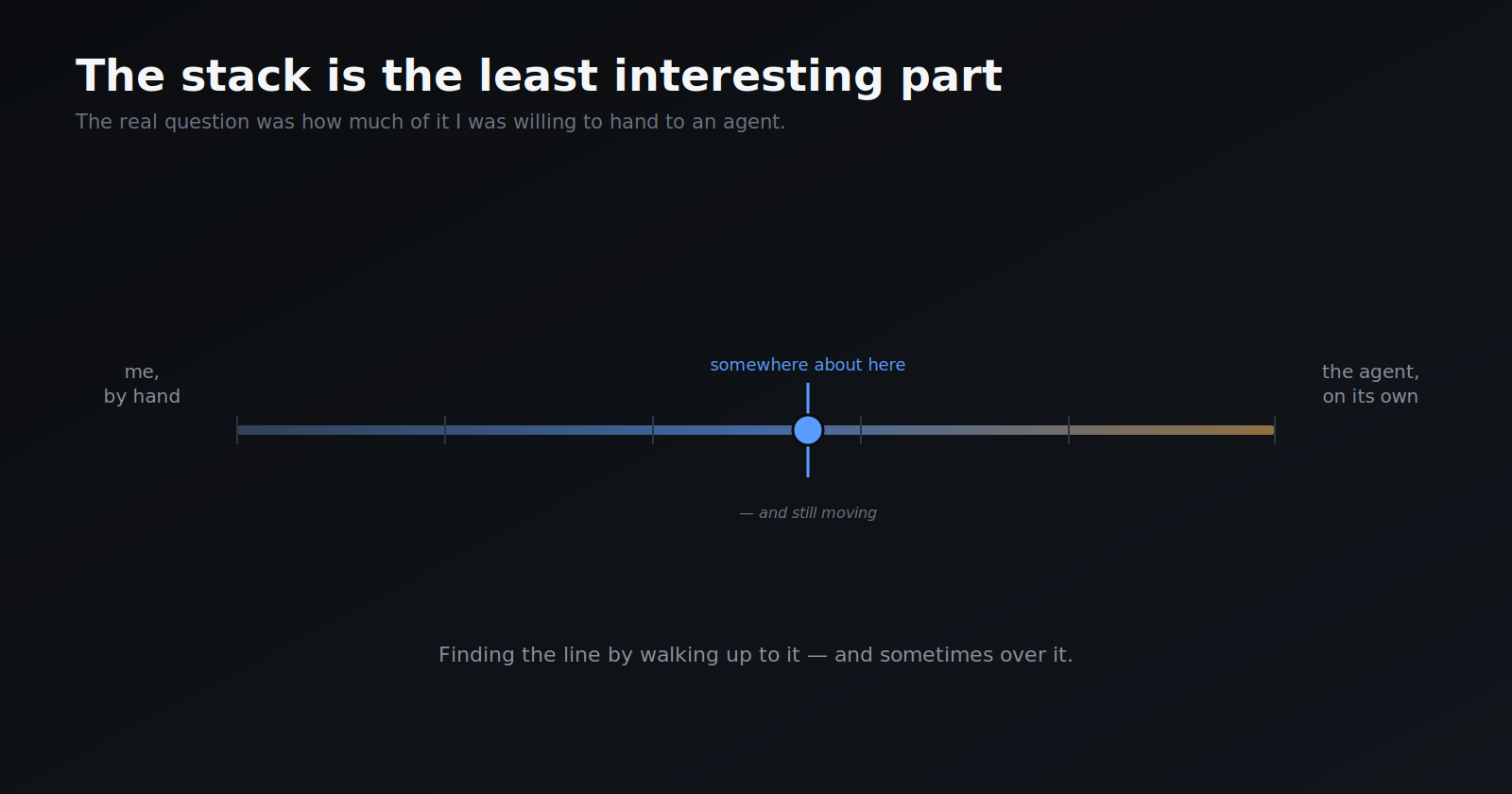
The site went live for its first real match this week, and a few people have asked how it’s built. I’ll answer that, but briefly, because the honest truth is the stack is the least interesting part of this whole thing.
Helidon and Oracle Java for the backend, Oracle Autonomous Database underneath it, React on the front, all of it on OCI and described in Terraform. If you’ve built for the web in the last decade none of that will surprise you, and in five years half of it will have changed anyway. Technology moves. Stacks move. Architecture evolves. For anyone who’s been doing this a while, choosing an architecture is not a new problem. I know what to expect, I know what to do, there’s nothing on that axis I haven’t seen before.
The interesting question was a different one, and it’s the reason I did this at all: how much of the work can I actually hand to an agent, and how comfortable am I doing it? And underneath that: what are the gotchas, what do I have to stay mindful of, and the question almost nobody asks out loud, would I even recommend working this way to someone else?
The part I don’t have twenty years of instinct for
Architecture change, I can reason about cold. Handing the work to an agent, I can’t. Not yet. That’s the paradigm I don’t have a career’s worth of instinct for, and that’s exactly why it was worth doing.
So the real experiment underneath the football app was calibration. How much do I let it run on its own? Where do I insist on being in the loop? What am I comfortable never looking at, and what would I never delegate no matter how good it got? Those aren’t questions with textbook answers, because the textbook hasn’t been written. You find the line by walking up to it, and sometimes over it. It destroyed my production host once (Part 3) because I’d set the line in the wrong place. That’s the cost of learning a paradigm nobody’s mapped yet.
I still don’t have a clean answer. What I have is a much better-calibrated sense of my own comfort than I had a month ago, which is the actual deliverable of a project like this, more than the app itself.
Take privileges. In Part 4 I wrote about the agent refusing to grant itself new power, the machine holding a line even I couldn’t talk it past. What I didn’t say is that I struggled with the same line from the other side. I started cautious, granting the agent as little as I could get away with. So it kept hitting walls and stalling, and I kept getting pulled in to unblock it. That got tiring fast, and so I over-corrected, opening things up broadly just to stop the interruptions. Which is exactly the trap. The broad grant is the easy way out when a blocked agent is nagging at you, and it quietly hands over far more than you meant to. The right level of access isn’t a decision you make once. It’s a thing you get wrong in both directions, too tight, then too loose, before you find the line. And the friction of being blocked pushes you toward over-granting at precisely the moment you should be scoping more carefully.
Building it is the easy half
Here’s the thing that surprised me most: getting an agent to build something is the easy part. Getting comfortable running what it built is the hard part.
A working demo is one thing. A live service that people are actually using, that has to keep working when you’re not watching, is a completely different bar. And you can’t be comfortable handing that to an agent unless you can see what’s happening inside it. Which is why the observability and monitoring work wasn’t a side-quest in this project. It was the whole point. You cannot offload what you cannot observe. The moment real users showed up, that stopped being a principle and became the thing I actually leaned on.
Why this project, specifically
There’s a professional reason I built this one and not some throwaway.
Running Oracle Java workloads well, knowing what versions are out there, keeping them current, watching how they behave in production, is exactly the problem space I work in day to day. Doing it on my own project, on my own free-tier instance, let me dogfood the tools I actually work with: standing up Oracle’s Java Management Service on my own fleet, seeing the on-ramp the way a customer would, finding the rough edges myself. It’s one thing to own a service. It’s another to be a user of it at 1am on a personal project, with no shortcuts, hitting the same walls anyone else would.
That turned out to be some of the most valuable work in the whole exercise, and it fed straight back into the day job. But that’s its own story for another time.
When is it enough?
The question I keep coming back to is: when is it enough?
For most of this project that was an architecture question. Enough features, enough tests, enough hardening to call it done. I know how to answer that one.
But now that it’s live and people are actually using it, “enough” has quietly become a bigger question than the one I started with. Enough autonomy handed to the agent? Enough of me still in the loop? Enough observability to sleep at night while a service I mostly didn’t type runs on its own?
Would I recommend working this way? Honestly, yes, but with eyes open. Not because it’s effortless (it isn’t), but because the only way to build the judgment for what’s coming is to actually do it, get burned in small ways, and learn where your own line sits. The gotchas in this series, the destroyed host, the bugs I couldn’t see, the cost I didn’t expect, aren’t reasons not to. They’re the curriculum.
I don’t have the full answer yet. Honestly, it’s turned into more than I anticipated when I started, which is usually the sign that a project was worth doing.
Next
The next post is the uncomfortable one about cost. The infrastructure ran for basically nothing. The agent did not. Where that cost actually came from is the part that surprised me.